Get Consultation from Experts
First Chat Free
Sign In
Enter your mobile number to continue
By signing in, you agree to our Terms Of Use and Privacy Policy
Download Our App For Better Experience


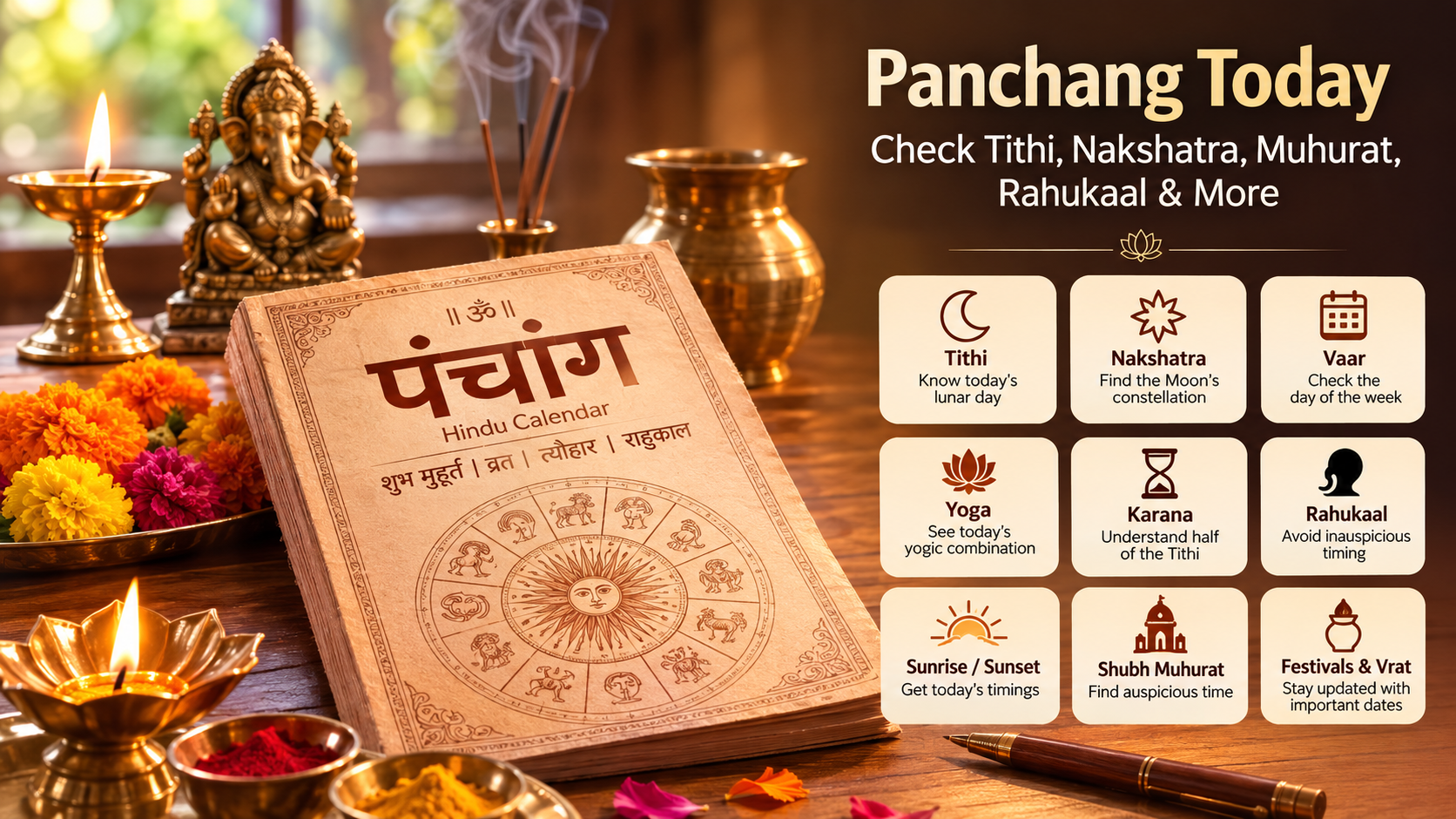
You ever wondered upon waking up in the morning and thought to yourself, “today is a good day to…” or “is today not a good day to…”? Well, checking the Panchang today is a simple way for many Indians to follow the morning ritual whilst connecting to traditional hindu astrology and lunar based Indian calendar.
With the Panchang you can find daily information about Tithi, Nakshatra, Yoga, Karana, Vaar, Rahukaal, sunrise, sunset, and Shubh Muhurat for the day. Whether you are a believer in daily astrology or just want a good time to begin your day, the Panchang is for you. Now that you know what the Panchang is, let us tell you just how useful it really is!
The word itself originates from sanskrit, with ‘pancha’ meaning 5, and ‘anga’ meaning body part. So Panchang literally translates to ‘five body parts’.
The traditional five elements of Panchang are:
1. Tithi
2. Vaar
3. Nakshatra
4. Yoga
5. Karana
All of which are calculated based on the longitudinal position (angle) of the sun and moon.
The Panchang is a traditional Hindu almanac that helps to determine auspicious time for rituals, and is widely followed by people across India. Now while previously the Panchang relied on a printed calendar, you can now easily read Panchang today from an online source.
Every day has its own Tithi, Nakshatra, Yoga, Karana, and more. This is why yesterday’s Panchang cannot be used for today!
People generally refer to the daily Panchang to know the following:
1. The today’s Tithi since many vrats, festivals, and pujas begin and end on a specific Tithi.
2. Rahukaal and Shubh Muhurat before beginning important activities, rituals, and events.
People may want to check the Panchang prior to:
• Starting a new business
• Opening up a new shop or office
• Buying a vehicle
• Buying a house or property
• Conducting a pooja
• Hosting a house warming ceremony
• Going on a trip journey
• Organizing a marriage ceremony
• Beginning a project
• Observing a vrat
• Conducting religious rituals
• Checking festival dates
• Checking auspicious time for any important activity
Of course, the Panchang is just one aspect for any important activity. It is important to also consider other factors such as expert opinions, along with personal considerations and circumstances.
When you look for the Panchang today you should know that the Panchang will have a lot of information. The Panchang today will include things like Tithi, Nakshatra, Yoga, Karana, Vaar, Rahukaal the time of sunrise the time of sunset and Shubh Muhurat. The Panchang is very useful because it has all this information, about the Panchang.
Below we provide a short description of each to help you understand what to look out for.
Tithi is one of the most important components of Panchang, and basically represents the lunar day. The Hindu lunar month consists of 30 Tithis beginning with the new moon and waxing up to the full moon, and then waning down to the next new moon.
In simpler terms, the lunar month is split into two equal halves:
1. Shukla Paksha – Waxing phase of the moon (increasing from new moon to full moon)
2. Krishna Paksha – Waning phase of the moon (decreasing from full moon to new moon)
Tithis are important since many festivals, vrats, and pujas are linked to the lunar day.
Common Tithis include Pratipada, Dwitiya, Tritiya, Chaturthi, Panchami, Shashti, Saptami, Ashtami, Navami, Dashami, Ekadashi, Dwadashi, Trayodashi, Chaturdashi, and Purnima or Amavasya (depending on whether it is a waxing or waning moon). When you check for the Panchang today, you will be able to see which Tithi it falls on today, as well as when it will end.
Another important component of Panchang is the Nakshatra, or lunar constellation. The sky is split into 27 Nakshatras. Which one falls on a certain day depends on where the moon is.
Each Nakshatra is unique, and has its own meaning and importance. Nakshatras are important as they help to determine Shubh Muhurat or auspicious time for various activities. They are also important in Jyotish or Vedic astrology for horoscope calculations, since the position of the moon at the time of birth determines your Nakshatra, and hence Kundali.
So when you refer to the daily Panchang, make sure to note which Nakshatra it falls on for the day.
Vaar simply refers to the day of the week. Sunday, Monday, Tuesday, Wednesday, Thursday, Friday, and Saturday are commonly associated with different planets.
For instance, Monday is ruled by the moon, whereas Thursday is ruled by Jupiter. Different activities are considered lucky or unlucky depending on which day of the week it falls on. This is why the week day is a vital part of the Panchang.
Yoga is another important component of the Panchang. It is determined based on the angle between the sun and moon. There are 27 Yogas. Although determining the yoga is not difficult, it requires accurate calculations.
A Panchang generally lists it out for you.
Karanas are another component of Panchang. They basically refer to the time taken to complete one Tithi. Since there are 30 Tithis in a month, there are 60 Karanas. However, they generally fall on two types of Karanas – odd and even.
Karanas are important since they along with Tithi, Nakshatra, and other factors are considered when deciding a Shubh Muhurat or auspicious time.
If you refer to the Panchang, you are almost bound to stumble upon Rahukaal, or Rahukaal Kaal.
Rahu is one of the shadow planets in astrology and is associated with negative energies. The Rahukaal is thus an inauspicious time when one should avoid beginning new activities.
The Rahukaal time varies from day to day since it depends on sunrise and sunset. So one can search Rahukaal today online to see what the timings are like. The Rahukaal is generally checked before beginning any task or activity.
However, the Panchang is purely a traditional reference, and you should not solely rely on it for important activities.
Shubh Muhurat refers to a lucky time. Most auspicious activities rely on a Shubh Muhurat. This includes house warming, new business opening, weddings, new job starting, buying property or a vehicle, and more.
The daily Panchang generally lists out different auspicious time slots throughout the day. So when looking out for an auspicious time for an activity, refer to the daily Panchang. You can also use a Shubh Muhurat calculator.
Brahma Muhurat occurs in the early morning, just before sunrise. Many hindus consider it to be a very auspicious time for meditation, prayers, and yoga.
Since it is before sunrise, it is mostly considered a calm and peaceful time to begin the day. So if you are someone who prefers to begin your day with spiritual activities, then make sure to note the daily Brahma Muhurat as it appears in the Panchang.
Abhijit Muhurat is another auspicious time that traditionally falls between 10 am to noon. However, it does depend on sunrise and sunset, so ensure that you refer to a Panchang that specifies the timings according to your local timings.
The Abhijit Muhurat is generally considered an auspicious time to begin activities, especially religious ones.
A good Panchang will also list sunrise and sunset. These are important times in the day that define when the day begins and ends.
Since it depends on your geographical location, there will be variation in timings from city to city. As an example, the sunrise time in Jaipur will be different from the sunrise time in Mumbai or Delhi. So it is generally better to refer to a good Panchang that will have the timings for your area.
You must often wonder “why can’t I use the same Panchang for two consecutive days since it is similar?” Well, the simple answer is that it is not similar due to astronomical calculations.
The Panchang varies from day to day because the position of the sun and moon changes. Hence, the Tithi, Yoga, Nakshatra, Karana, and other details vary. Even for sunrise and sunset, the timings vary as it depends on where you are located.
So although it may seem similar to the previous day, there are always slight differences. This is why it is important to refer to Panchang today as opposed to using a Panchang from a couple of days ago.
The Panchang is important in reference to Hindu festivals. Since many festivals fall on a specific Tithi, it is always advised to cross check the festival date as per the Panchang.
Festivals such as Diwali, Holi, Janmashtami, Navratri, Maha Shivratri, Ganesh Chaturthi, Ram Navami, Ekadashi, and more fall on specific Tithis and hence are linked to the Panchang.
So before any religious activity for the festival, ensure that you refer to the daily Panchang to check the Tithi, Shubh Muhurat, and more.
If you are the type of person who fasts on religious days or observe a vrat, it is important to refer to the Panchang to keep track of important dates.
Most vrats fall on a specific Tithi. As an example Ekadashi happens on the day of the moons cycle. This happens during the part of the moon when it is growing bigger called Shukla Paksha and also during the part when it is getting smaller called Krishna Paksha. Because of this Ekadashi is celebrated twice each month. There are other religious activities that are connected to the moons month. That is why having a good Panchang is important to remember and follow religious practices.
There is no better feeling than beginning a new chapter of your life at the right moment. While many things are out of our control, it is always important to make sure that new beginnings happen on an auspicious day, during an auspicious time.
Whether you are starting a new business, moving into a new house, starting a new job, or beginning a new project, an auspicious Muhurat calculator like the Panchang is always handy. While life today is fast-paced, it is these small rituals that help connect one to their traditions. For many, Panchang is one way to ensure they are following the traditions. It may also help to have good morning thoughts as you follow the daily rituals.
You can even make it more interesting by checking out the daily Panchang, ascertaining the Tithi, and noting the Shubh Muhurat. Who knows, you may just have the perfect day to begin something new!
Yes, you can check the Panchang online. In fact, it has never been easier since you can access a good Panchang from the convenience of your computer or phone. Previously, people used to refer to the Panchang from a book or directly to the priest. So now you can check the Panchang for today and get all the important timings online.
The benefits of checking the Panchang online include finding the following:
1. Today’s Tithi
2. Nakshatra
3. Yoga
4. Karana
5. Vaar
6. Rahukaal
7. Shubh Muhutar
8. Brahma Muhurat
9. Abhijit Muhurat
10. Sunrise
11. Sunset
12. Moonrise and moonset
13. Festival
14. Vrat
Having all of this information in one place is a fantastic way to check your daily Panchang.
Astromanzil is your one-stop-shop for Panchang and other astrology related queries. You can easily access the daily Panchang on your computer or phone using the Astromanzil app or website.
So whether you are looking for the today’s Tithi before observing a vrat, checking Rahukaal, looking for a Shubh Muhurat, or simply want to read the day’s Panchang, make sure to use Astromanzil for your daily rituals.
Modern times have transformed the way we live. We no longer have to stick to the traditional ways and it has become much easier to complete daily tasks. From online banking to video calling, all we have to do is a simple click of a button.
However, one aspect of life that has remained consistent throughout the decades is the Panchang.
Why do people still follow the Panchang? Well, for some it is a way to connect to their roots.
For others it is a morning routine where they can check the day’s Panchang and follow the traditional astrological calculations. It may even serve as a reminder to keep track of festivals and important religious activities. Whatever the reason may be, many continue to refer to the Panchang in an effort to keep up with their traditions.
No they are not the same thing. The horoscope and the Panchang are thought to be the same. The horoscope is really about your zodiac sign and what is going to happen to you. On the hand the Panchang is mainly about the daily Tithi and other important times, for astrology. The horoscope tells you things that will happen to you because of your zodiac sign. The Panchang tells you about the Tithi and other astrological timings.
So in short,
Horoscope: What will happen to me?
Panchang: When will it happen?
Both can be used hand-in-hand to determine your day.
Do not get overwhelmed by all the timings. If you are not well-versed with the Panchang, you can opt to only check a few important timings.
First, check the day’s Tithi and then ascertain the Nakshatra. You then need to look out for the Rahukaal and Shubh Muhurat if you have any important activity planned for the day.
Finally, note the sunrise and sunset. These are some of the most important timings to note for the day. As you get more familiar with the Panchang, you can choose to look out for other timings such as Yoga, Karana, Abhijit Muhurat, Brahma Muhurat, and more.
The Panchang today is a way to find out the daily Tithi, Nakshatra and other important times. From Shubh Muhurat to Rahukaal the Panchang works as a guide for religious festivals, vrats and important activities. So whether you want to check if a particular day is good, for starting something or just want to connect with your traditions the Panchang is a great way to begin your day.
You can check today’s Panchang to determine the auspicious timings of the day.Make it a point to check the Panchang every morning and remember the important timings.
Do not forget to follow Astromanzil for all your astrology, Panchang, and spirituality needs.