Get Consultation from Experts
First Chat Free
Sign In
Enter your mobile number to continue
By signing in, you agree to our Terms Of Use and Privacy Policy
Download Our App For Better Experience


Marriage is definitely a step. In India it is mostly a gathering of two families along with their customs and numerous debates about the future. In this tangled web of debates one query will definitely pop up “Kundali match hui hai?”
For ages Kundali matching has been an important ritual for Indian families. It has its share of believers and those who believe it to be a mere ritual and nothing more than that. What actually happens during kundali matching? What are *gunas*? Do you really need a score of 36 out of 36? What is Mangal Dosha?. Where can you get a kundali matched easily?
Let us break it all down using simple, everyday language.
Kundali Matching, which people also call **Kundli Milan** or **Guna Milan** is a practice in astrology. It involves comparing the birth charts of two people before they get married.
A birth chart is usually made using details like:
* Date of birth
* Exact time of birth
* Place of birth
experts then look at these charts to see how compatible the two people might be.
The common method is **Ashtakoota Milan**. This method looks at eight areas of compatibility and gives a total score out of **36 gunas**. You might have heard someone say, "36 mein se 28 gun mil rahe hain." That number comes directly from this system.
However kundali matching is about more than looking at a final number.
The old reason for kundali matching is to see if two people are astrologically a match. It is used to look at things like how people act how they talk to each other their emotions, their family life and other parts of life.
For families kundali matching also gives a structured way to include elders and traditional beliefs in the wedding process.
Today couples look at **kundali matching** in ways. Some see it as a spiritual tradition while others just want to see what the charts say without letting astrology make the final decision for them.
There is no way that everyone handles it.
The known **36-guna system** comes from Ashtakoota Milan.
The eight kootas are:
1. Varna
2. Vashya
3. Tara
4. Yoni
5. Graha Maitri
6. Gana
7. Bhakoot
8. Nadi
Each group has a number of points and together they add up to 36.
Let us look at what each one usually stands for.
Varna is usually about values, how a person sees the world and spiritual matching. It gives **1 point** in the Ashtakoota system.
Vashya is often about attraction, influence and how a couple relates to each other. It gives **2 points**. The goal here is to see how naturally the two people might influence one another.
Tara Koota is linked to being, luck and how well people match based on their birth stars or **nakshatras**. This adds **3 points** to the score.
Yoni Koota represents how people connect on a level. It gives **4 points**. In astrology different nakshatras belong to yoni groups, which are then compared.
Graha Maitri looks at the friendship between the influences of the two people. It adds **5 points**. This part of kundali matching is used to see how easily the two people might talk and connect.
Gana is about personality and temperament. It gives **6 points** making it an important part of the Ashtakoota system. The traditional groups are Deva, Manushya and Rakshasa. These terms describe types of personalities rather than saying someone is "good" or "bad."
Bhakoot gives **7 points**. It is tied to compatibility, family life, prosperity and how the relationship works overall. Because it has many points Bhakoot is often a major focus during traditional kundali analysis.
Nadi is the part of the Ashtakoota system with **8 points**. It is linked to health, physical makeup and family matters.
If both people have the Nadi it might be called **Nadi Dosha** in traditional astrology. However astrologers often look for ways this might be cancelled out of just saying the match is bad.
This is why a final score can sometimes be a bit misleading.
A common rule of thumb is that **18 out of 36 gunas** is a score.
People often look at scores like this:
* **Below 18:** Usually seen as compatibility
* **18–24:** Often seen as a range
* **25–32:** Generally seen as compatibility
* **33–36:** Seen as high compatibility
But please do not treat these numbers like strict laws. A couple with 32 gunas is not promised a marriage just like a couple with 20 gunas is not destined to have nothing but problems.
Why is that? Because **Guna Milan is one part of traditional kundali analysis.**
Experts also look at birth charts, where planets are placed, different houses, doshas and many other things.
It sounds perfect right? Getting a perfect score is not actually necessary. A high score just means the scoring system shows they are compatible. It does not mean the two people will never fight or face times.
No two people are exactly the same, even then couples who share many characteristics will differ in their opinion, habits, language, and priorities. A good marriage does not mean the partners have to have no difference in these areas, but rather that they have to know how to deal with said differences which is why I believe that kundalis shouldn't be used as an indicator of whether or not your scores equal marriage.
If you've ever listened to marriage counseling discussions, you've probably come across the term Mangal Dosha. Mangal Dosha also known as Manglik Dosha is a vedic astrological term that determines the placement of planet Mars is in a person's birth chart.
A person who has had this placement in their birth chart is said to be a "Manglik". However things are not always as simple as they seem on the internet. Different traditions have ways of checking Mangal Dosha. Astrologers also look at Mars and other planets to see the picture. There are also beliefs that certain things can reduce or cancel out the effects of Mangal Dosha. So seeing the word "Manglik" on a report does not tell the whole story.
Nadi Dosha is another topic that comes up during kundali matching. It happens traditionally when both people have the Nadi classification. Since Nadi makes up **8 out of 36 points** it can change the Guna Milan score quite a bit.
Traditional astrology links Nadi to health and family matters. However astrologers will also check if there are exceptions that cancel out the dosha. This is why a deep explanation is more helpful than just seeing a warning on a website.
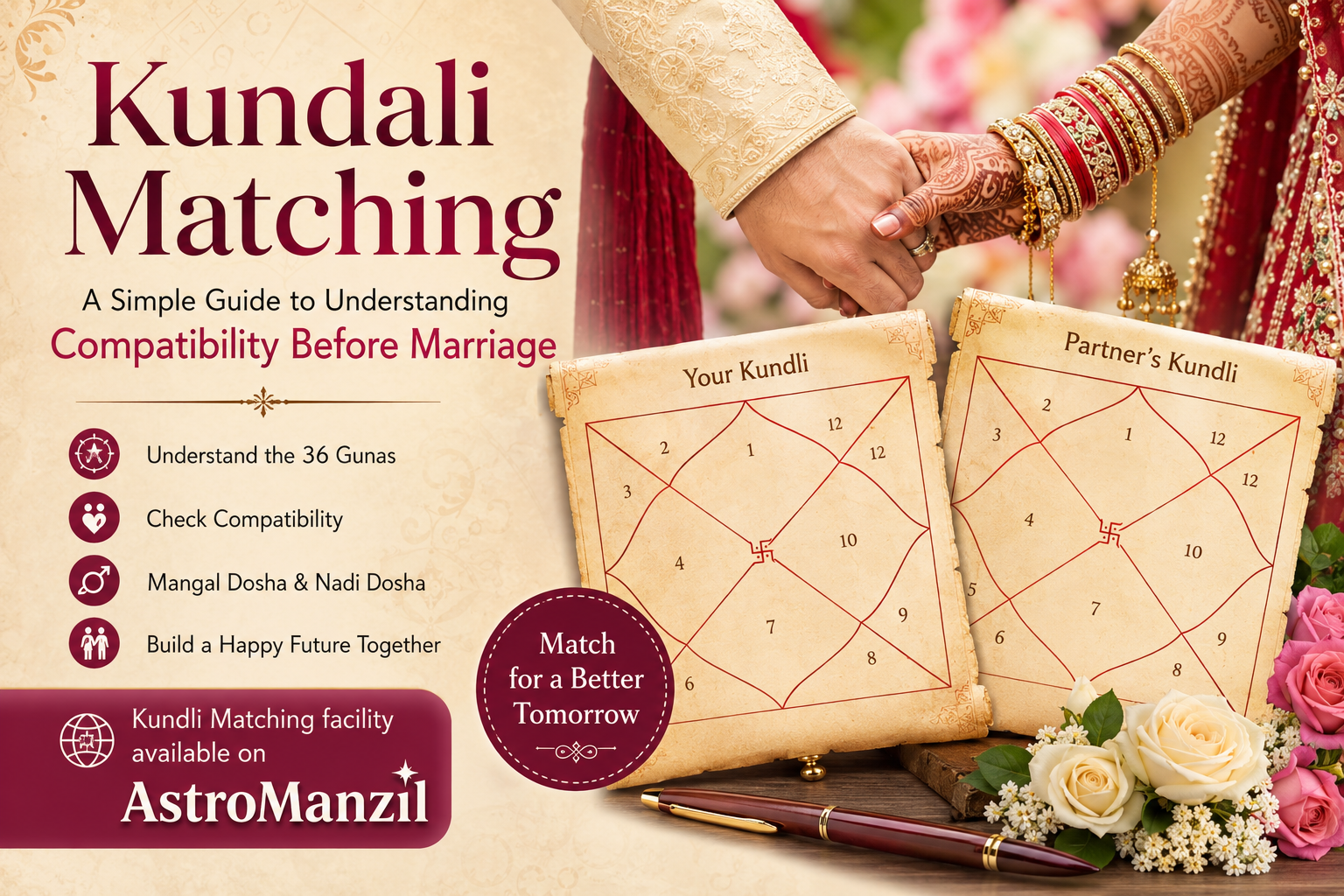
Because of technology you do not always have to go see an astrologer in person to get a kundali matching report. If you would like a method AstroManzil provides a Kundli Matching facility where you can match two birth charts to see if they are compatible by using their information.
This is very handy if you want to check everything from your home. To get the result make sure the birth details you type in are correct including the date, time and place of birth.
**AstroManzil’s Kundli Matching facility can be a starting point for couples and families who want to look into traditional astrological compatibility before marriage.**
It is important to keep your expectations realistic. Kundali matching is a *traditional astrological practice**, not a scientific way to predict if a marriage will work. No birth-chart score can guarantee a life together.
A real relationship depends on things in the world like how you talk, if you trust each other, respect, being emotionally mature sharing chores money decisions, family life and how you handle fights.
So if you choose to do kundali matching think of it as a practice rather than a guaranteed map of your future.
Imagine two people whose kundalis show they are a match.. In real life they argue about money, jobs, where to live or if they want kids. Will a high score fix those problems? No.
Now imagine another couple whose kundali score's not very high but they talk openly respect each other support each others goals and know how to fix their arguments. This proves that **Real-life compatibility matters.** If you are thinking about marriage astrology can be one part of the conversation. It should not replace getting to know the person.
Whether you believe in astrology or not there are some things you should talk about before getting married.
What does each person want to do for work? Would they be okay with moving to a city if they had to? What happens if one person needs to change their career path? Talking about these things can stop arguments later on.
Money is a huge part of living together. Couples should talk about how they will save money how they will spend money, who will pay for what and how to handle costs in the future.
In India families are often very involved in your life. It is an idea to know what each person expects regarding family help, traditions, duties and having personal space.
If you both want kids you should talk about how you want to raise them and what your duties will be as parents.
tiny differences can start to bother you over time. Things like what time you sleep your life, what food you eat, travel, personal space and who does the chores can all matter in a marriage.
Maybe the important question is a simple one: **Can you talk honestly with each other?** A relationship is much easier to handle when both people feel safe talking about problems of hiding them.
Whether you use a service like AstroManzil or go to see an astrologer in person you need the birth information to get it right. You will usually need:
* Full date of birth
* Exact birth time
* Birthplace
If the birth time is wrong the parts of the birth chart might change because of how the math works. So before you start the Kundali Matching process it is an idea to check your official birth records if you can.
Do not rush to a decision because of one number. If a report shows gunas than you expected a traditional astrologer might look at the whole chart and other factors before telling you what it means. At the time couples and families should think about how they actually get along in real life. A low score should not make you panic. A high score should not make you ignore real problems. Think of the Kundali Matching score as **one piece of information not the picture.**
Yes it is.. Maybe it is different now than it was for our grandparents. In the past marriages were often. Couples did not always get to know each other first. Kundali Matching was one way families checked if people were a match. Today people have the chance to meet, talk, study and work together to understand each others personalities before marriage. Because of this Kundali Matching can work alongside talks about being compatible. For some it is an cultural tradition. For others it is something they do because their families value it. With platforms like **AstroManzil** Kundali Matching has become easier for people who want to look into it without having to go to an astrologer.
This is not true. A high score does not show every part of two peoples personalities or how they will actually act together.
This is too simple. A traditional astrologer will often look at other factors before making a final choice.
Mangal Dosha is looked at as part of the whole birth chart. Traditional astrology also has rules and exceptions for it.
No score on a birth chart can guarantee that a relationship will be perfect.
A birth chart cannot replace talking understanding each other and truly getting to know a person.
Kundali Matching is an ancient art which has been existing in the country for ages and it is something that people as well as families that seek to get married have come to appreciate over time. It mainly uses the Ashta Koota method which analyses eight different aspects using 36 gunas. Gana, Bhakoot, Nadi and Mangal Dosha are among the other factors that can be used when doing kundali matching depending on the method selected. To test your compatibility, AstroManzils Kundli Matching Facility is a perfect option as it only requires people to enter the required information and click on a button.
Perhaps the best approach to Kundali Matching in the current context would be to utilise it as a tool for guidance rather than an absolute necessity. After all, a person’s birth chart can be an extremely interesting point of exploration for those who are particularly invested into astrology. Ultimately, any marriage is a bond between two people, therefore respect, open communication, trustworthiness and the ability to rely on each other no matter the circumstances are the traits that are most important in a marriage
So before you ask *"Kitne gun mil rahe hain?"* ask yourself these questions: **Do we understand each other? Can we talk honestly? Do we respect each others choices? Are our goals, for the future the same?** Whether you believe deeply in Kundali Matching or just follow it as a tradition these questions will help you see what really matters when two people decide to build a life.